ECCV 2026
*Corresponding author
No multi-view supervision. We reuse frozen, off-the-shelf single-view HMR models as priors and only optimize at inference time.
No extrinsics, no intrinsics, no cumbersome rig calibration — the method generalizes to arbitrary, unseen camera configurations.
A drop-in test-time adaptation paradigm that improves any pretrained single-view backbone it is wrapped around.
Surpasses multi-view models that were trained with explicit multi-view supervision, under the same camera setups.
Multi-view human mesh recovery (HMR) is broadly deployed in diverse domains where high accuracy and strong generalization are essential. Existing approaches can be broadly grouped into geometry-based and learning-based methods. However, geometry-based methods (e.g., triangulation) rely on cumbersome camera calibration, while learning-based approaches often generalize poorly to unseen camera configurations due to the lack of multi-view training data, limiting their performance in real-world scenarios. To enable calibration-free reconstruction that generalizes to arbitrary camera setups, we propose a training-free framework that leverages pretrained single-view HMR models as strong priors, eliminating the need for multi-view training data. Our method first constructs a robust and consistent multi-view initialization from single-view predictions, and then refines it via test-time optimization guided by multi-view consistency and anatomical constraints. Extensive experiments demonstrate state-of-the-art performance on standard benchmarks, surpassing multi-view models trained with explicit multi-view supervision.
Human Mesh RecoveryMulti-ViewTest-Time Adaptation
An overview of the method, the test-time adaptation procedure, and qualitative results.
Two stages, both at test time, both with a frozen backbone.
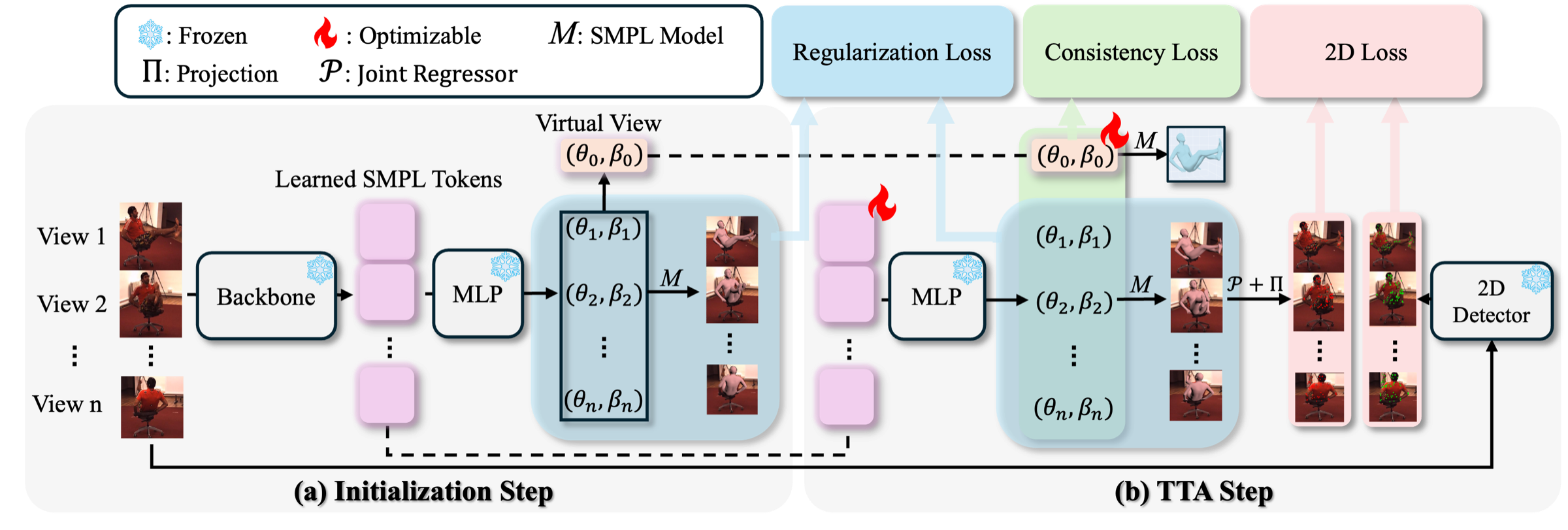
A frozen single-view HMR backbone produces an SMPL estimate for every camera. Because each view carries its own depth ambiguity and occlusion pattern, no single estimate is trustworthy on its own. We aggregate them into one additional set of SMPL parameters — the virtual view — which represents a unified, robust hypothesis of the body across all cameras and serves as the starting point for refinement.
We then optimize the per-view tokens and the virtual-view parameters directly on the test sample, under three objectives: a 2D loss that re-projects the mesh and aligns it with detected keypoints, a multi-view consistency loss that forces every view to agree with the virtual view, and a regularization loss that keeps the solution from drifting away from the reliable single-view prior. The camera geometry is never needed explicitly — consistency does the work calibration usually does.
In-the-wild multi-view captures from the RICH dataset, compared against HeatFormer and U-HMR. Each panel shows four synchronized cameras; rows are, from top to bottom, Input, Ours, HeatFormer and U-HMR. Use the chapter list to jump between sequences.
All 56 sequences of the Human3.6M evaluation split (subjects S9 and S11), four synchronized cameras each. The top row is the input view; the bottom row is MonoMV after multi-view test-time adaptation. Use the chapter list to jump between sequences.
@inproceedings{xie2026monomv,
  title     = {Monocular Models are Strong Learners for Multi-View Human Mesh Recovery},
  author    = {Xie, Haoyu and Xu, Shengkai and Guo, Cheng and Saleem, Muhammad Usama
               and Wu, Wenhan and Chen, Chen and Helmy, Ahmed and Wang, Pu and Xue, Hongfei},
  booktitle = {European Conference on Computer Vision (ECCV)},
  year      = {2026}
}